
Right bins. Right lifts.
General waste, dry mixed recycling, glass and food waste collections, sized to what your business actually throws away and how often the bins fill up. We arrange it with registered waste carriers, and the paperwork your duty of care asks for comes with it.
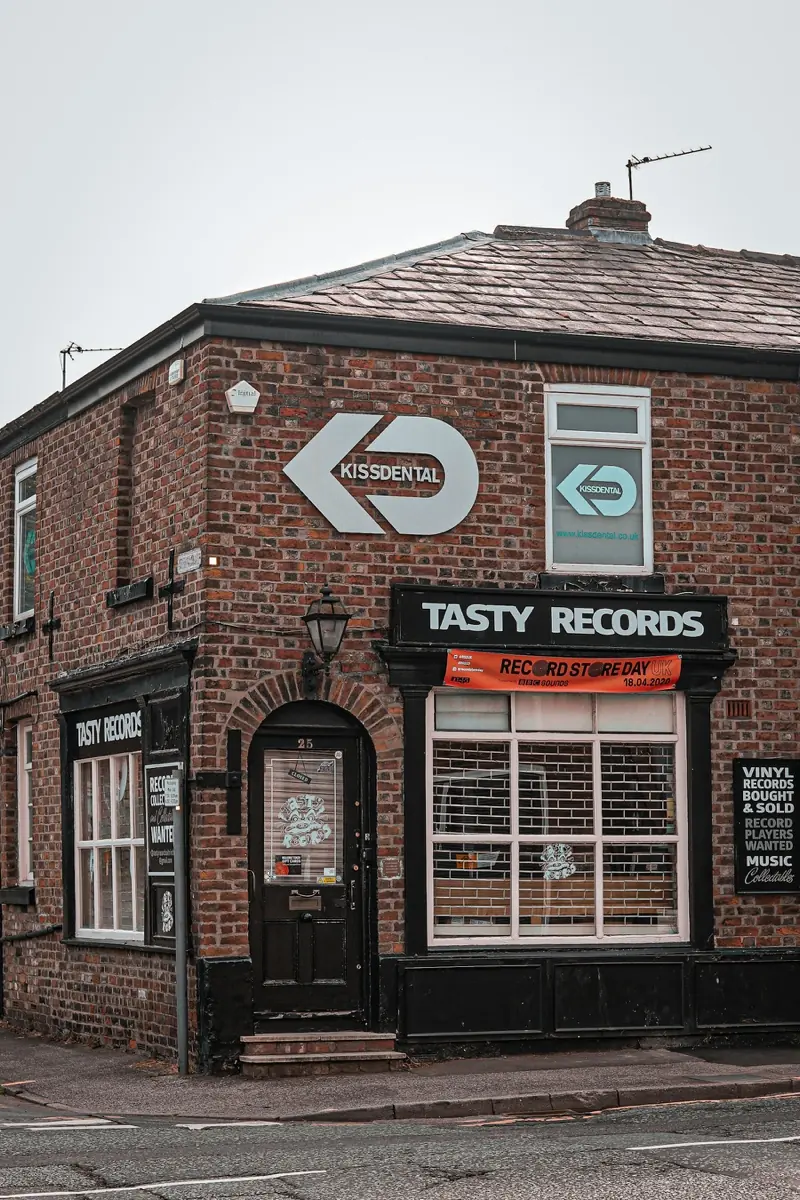
Tasty Records, Altrincham. Stock for a shop like this arrives boxed in cardboard, so even a small shop needs its recycling collected as often as its general waste.
Four bins, sized to what you fill
You pay for the bins and for every lift. A bin that's half empty at each collection, or overflowing by Wednesday, is the wrong size. We look at what you throw away and set the bins and lifts to match.
- General waste
- Whatever's left once the recycling and food are out. The bin that shrinks when you sort the rest properly.
- Dry mixed recycling
- Paper, card, plastic bottles and tubs, tins and cans, together in one bin. Flatten the boxes and it lasts twice as long.
- Glass
- Bottles and jars. Pubs and restaurants fill these faster than anything else, so they often need lifting more than once a week.
- Food waste
- Kitchen scraps and plate waste in a sealed bin. For most workplaces in England it now has to be kept separate.
Your duty of care
The law makes a business responsible for its waste until it's handed to someone authorised to take it. If your rubbish turns up fly-tipped and is traced back to you, the first question is who you gave it to.
Every collection we arrange is with a registered waste carrier, and the paperwork comes with it.
What the law asks of you
- Only give your waste to a registered waste carrier.
- Get a waste transfer note saying what the waste is and who took it.
- Keep your waste transfer notes for at least two years.
- Store waste so it can't escape: lids shut, bins somewhere secure.
Simpler Recycling: two dates to know
In England, workplaces now have to separate dry recyclables and food waste from general waste. When it applies to you depends on how many people you employ.
March 2025
31
Workplaces with 10 or more employees
March 2027
31
Micro-firms with fewer than 10 employees
If you're under 10 employees you have until 2027, but adding a food bin and a recycling bin now usually means a smaller general waste bin, and fewer lifts of it.
Waste questions we get asked
What size bins can I have?
Two-wheeled bins of around 140, 240 and 360 litres, and four-wheeled bins of 660 and 1,100 litres. We size them to how much you actually fill, so you're not paying to empty air.
How often will my bins be emptied?
As often as you need. Each emptying of one bin is called a lift, and collections are usually priced per lift. Weekly, fortnightly or several times a week, depending on how fast you fill them.
Do I have to separate food waste?
In England, under Simpler Recycling, workplaces with 10 or more employees have had to separate dry recyclables and food waste since 31 March 2025. Micro-firms with fewer than 10 employees have to from 31 March 2027.
What is a waste transfer note?
A record of the waste you hand over: what it is, how much, and who's taking it. Your collector should provide them. Keep them for at least two years, as part of your duty of care.
What do you need from me to get a quote?
What you have now: how many bins, what size, what goes in them and how often they're emptied. Your latest invoice from your current collector covers most of it.
Tell us what's in your bins.
How many, what size, how often they're emptied. We'll price collections to match and ring you back. Or call 0161 814 9299 and ask about waste.